
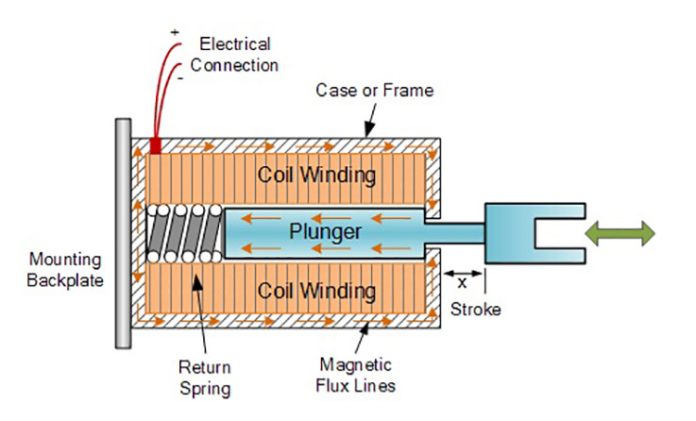


Voice coil motors are widely used in precision motion systems where accurate force control, fast response, and smooth linear movement are required. Their electromagnetic operating principle allows direct conversion of electrical energy into mechanical force, making them essential in modern automation, robotics, and high-precision industrial equipment.
In advanced motion control systems, a voice coil motor is valued for its direct-drive architecture, which eliminates gears, belts, and screw mechanisms. This enables frictionless motion, highly responsive force output, and excellent positioning accuracy in applications that demand fine and repeatable control.
Fundamentals of Force Generation
The force generation in a voice coil motor is based on the Lorentz force principle. When an electric current flows through a coil placed within a permanent magnetic field, a force is produced perpendicular to both the magnetic field and the current direction.
This fundamental interaction allows precise control of force by simply adjusting the input current. The relationship is linear, meaning that increasing current results in a proportional increase in force output.
Key aspects of force generation include:
- Force is directly proportional to coil current
- Direction of force depends on current polarity
- Magnetic field provides a constant reference environment
- No mechanical contact during force production
This simplicity enables extremely accurate and repeatable force control.
Role of Magnetic Field in Force Control
The magnetic field is a critical element in determining the performance of a voice coil motor. A stable and uniform magnetic field ensures consistent force output across the entire motion range.
Important design factors include:
- Use of high-strength rare-earth magnets such as neodymium
- Optimized air gap for uniform flux distribution
- Low magnetic leakage for efficient operation
- Stable magnetic circuit design for repeatability
A well-engineered magnetic system ensures predictable force behavior even under varying operating conditions.
Electrical Current and Precision Control
Force control in a voice coil motor is achieved by precisely regulating the electrical current supplied to the coil. Advanced controllers continuously adjust current based on feedback from sensors.
This control mechanism enables:
- Fine adjustment of output force in real time
- Smooth transitions between force levels
- High-resolution motion control
- Stable performance under dynamic loads
Because of this direct relationship, even small changes in current produce highly controlled motion responses.
Closed-Loop Control Systems
To achieve high precision, voice coil motors are typically integrated into closed-loop control systems. These systems use sensors to monitor position, velocity, or force and adjust current accordingly.
A typical control loop includes:
- Position or force sensors (encoders, capacitive sensors, or laser systems)
- A controller that processes feedback signals
- A power driver that adjusts coil current
This feedback mechanism ensures accurate and stable operation even in complex environments.
Factors Affecting Force Accuracy
Several factors can influence the accuracy and stability of force generation in a voice coil motor:
- Temperature variations affecting coil resistance
- Magnetic field non-uniformity
- Mechanical alignment of coil and magnet
- Load variations during operation
- Electrical noise in control signals
Proper system design and calibration help minimize these effects and maintain high precision.
Advantages of Electromagnetic Force Control
Voice coil motors offer several advantages compared to traditional mechanical force systems:
- Instantaneous force response
- High precision and repeatability
- Smooth and vibration-free operation
- No mechanical backlash or wear
- Simple yet highly effective structure
These benefits make them ideal for demanding precision applications.
Applications of Force-Controlled Systems
Voice coil motors are widely used in systems where precise force regulation is critical, including:
- Semiconductor wafer positioning systems
- Optical alignment and focusing equipment
- Medical diagnostic and surgical devices
- Precision testing and calibration systems
- Robotics requiring controlled force interaction
In these applications, consistent and accurate force control directly impacts performance quality.
Conclusion
Voice coil motors achieve precise force generation and control through electromagnetic interaction, stable magnetic field design, and real-time current regulation. Their direct-drive structure enables fast, accurate, and repeatable force control, making them essential in modern high-precision motion systems. As automation technology continues to advance, voice coil motor control mechanisms will remain a key foundation of precision engineering solutions.